What the Democracy Labs Game Includes and How It Works
How to Play & Components
The Game Includes
Role cards
Role cards invite players to speak from different positions (for example, Resident, Government Representative or Innovator), supporting perspective-taking.
Problem cards
Problem cards present democracy-related challenges based on the Democracy Labs workshops and public trials of design-fiction stories, all run during the INCITE-DEM project.
Scale cards
Scale cards indicate whether the problem should be tackled at the local, regional or national level. Treat Scale as a lens that constrains the problem (scope, audience, reach).
Values cards
Values cards show democratic and societal values that can guide possible solutions.
Implementation cards
Implementation cards contain ideas and fragments of possible solutions based on ideas generated in the Labs and participants’ feedback on the fictional stories. They help players reflect on and further develop these solutions. Implementation cards are building blocks that can be combined, adapted, or rewritten, they are not final solutions.
Action cards
Action cards encourage players to adapt, combine, extend and create new ideas, helping them move from reflection to action.
Glimpse to the future (action cards)
Glimpse to the Future mini-deck – small visual and textual cards that offer open glimpses of possible futures and can be used as optional inspiration during ideation; part of action cards.
Ideation cards
Ideation cards are blank cards for players to sketch their own ideas.
Game boards
Game boards that make the game flow easier to follow include:
• Card Deck Board helps organise the cards decks on the table, keeping the process clear;
• Future-Making Board includes zones where players can put certain cards they discuss, and make notes if needed;
• Innovation–Feasibility matrix guides the final evaluation and decision.
Instructions sheet
Instruction sheet is a step-by-step guide that explains the goal, flow, and rules of the game.
Game Unboxing
How to Play
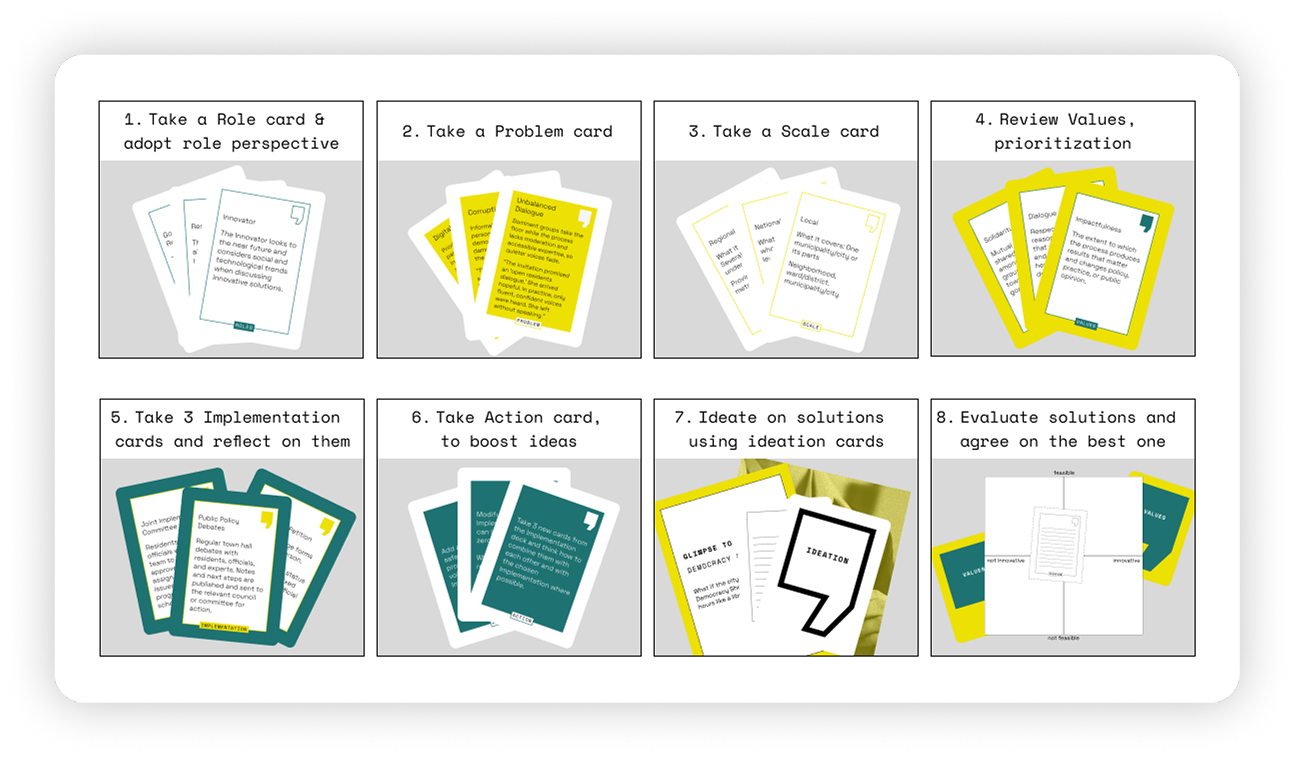
Setup
The players prepare the materials by printing and cutting the files, sorting the cards into named decks, placing the boards on the table, and shuffling the decks.
2. Problem
The players draw a Problem card and read it aloud, so all players start from a shared understanding of the challenge.
4. Values
The players review the Values cards and discuss which values are at risk and which values the solution should actively support. The players agree on 3 to 5 priority values and keep the chosen cards visible throughout the round.
6. Action
Each player draws one Action card and uses it to modify the proposed solution from the Role perspective. The players can use blank Ideation cards when they want to introduce a completely new idea, and they briefly re-pitch the updated proposals.
8.1 Evaluation
The players place each candidate proposal on the Innovation-Feasibility matrix and discuss how innovative and how feasible each option is, and whether it strengthens democratic participation in a meaningful way.
1. Roles
Each player draws a Role card, places it face up, and briefly introduces the perspective they will represent during the session.
3. Scale
The players draw a Scale card and treat it as a lens that frames the Problem by setting the scope, audience, and reach of the solution.
5. Implementation
Each player draws three Implementation cards and privately chooses one or two to bring into the discussion. The players reveal their selected cards, give short pitches for why they chose them, and treat the cards as building blocks rather than final solutions. If a player receives an unhelpful set, the rules allow one mulligan before revealing, where the player discards three cards and draws three new ones.
7. Ideation
The players expand, combine, and refine the proposals using the Ideation cards, so the discussion moves from candidate building blocks to clearer solution options.
8.2 Agreement
The players return to the priority Values, check which values each proposal supports and which remain uncovered, and agree on one solution that is feasible enough, innovative enough, and aligned with the chosen values. The round ends with agreement, and it ends without a shared solution if the players cannot reach agreement.
Setup
The players prepare the materials by printing and cutting the files, sorting the cards into named decks, placing the boards on the table, and shuffling the decks.
1. Roles
Each player draws a Role card, places it face up, and briefly introduces the perspective they will represent during the session.
2. Problem
The players draw a Problem card and read it aloud, so all players start from a shared understanding of the challenge.
3. Scale
The players draw a Scale card and treat it as a lens that frames the Problem by setting the scope, audience, and reach of the solution.
4. Values
The players review the Values cards and discuss which values are at risk and which values the solution should actively support. The players agree on 3 to 5 priority values and keep the chosen cards visible throughout the round.
5. Implementation
Each player draws three Implementation cards and privately chooses one or two to bring into the discussion. The players reveal their selected cards, give short pitches for why they chose them, and treat the cards as building blocks rather than final solutions. If a player receives an unhelpful set, the rules allow one mulligan before revealing, where the player discards three cards and draws three new ones.
6. Action
Each player draws one Action card and uses it to modify the proposed solution from the Role perspective. The players can use blank Ideation cards when they want to introduce a completely new idea, and they briefly re-pitch the updated proposals.
7. Ideation
The players expand, combine, and refine the proposals using the Ideation cards, so the discussion moves from candidate building blocks to clearer solution options.
8.1 Evaluation
The players place each candidate proposal on the Innovation-Feasibility matrix and discuss how innovative and how feasible each option is, and whether it strengthens democratic participation in a meaningful way.
8.2 Agreement
The players return to the priority Values, check which values each proposal supports and which remain uncovered, and agree on one solution that is feasible enough, innovative enough, and aligned with the chosen values. The round ends with agreement, and it ends without a shared solution if the players cannot reach agreement.